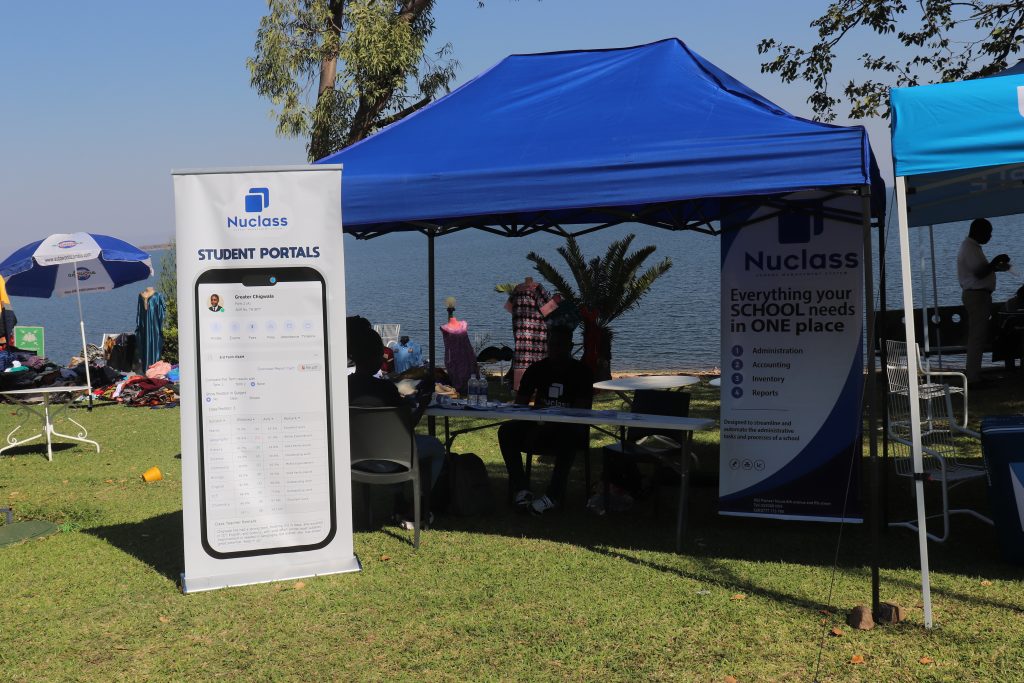
NuClass engaging school Heads through live demonstrations of its digital school management system at 2025 NASH CONFERENCE in Kariba, Zimbabwe.
How to Digitalise My School in Zimbabwe: A Practical, Step-by-Step Guide for 2026.
How to digitalise my school in Zimbabwe is a question many school heads are asking as education systems modernise across the country. Digital transformation is happening across Zimbabwe — from banking, farming, and transportation to hospitals and government systems. Schools are now joining this movement, not because technology is a trend, but because manual school administration is no longer sustainable.
Every term, school heads across the country are asking:
“How can I digitalise my school in a simple, affordable way?”
Digitalising a school does not mean buying expensive computers or creating complex IT systems. It means using smart, simple tools that reduce paperwork, strengthen communication, and improve the learning environment.
In this blog, you’ll learn exactly how to digitalise your school step-by-step, the benefits, common mistakes to avoid, and why tools like NuClass are making it easier than ever for Zimbabwean schools to modernise.
1. What Does “Digitalise a School” Really Mean?
Most people imagine:
- big computer labs
- expensive Wi-Fi networks
- complicated software
- IT specialists and servers
But that’s not what digitalising means — especially in Zimbabwe.
To digitalise a school simply means:
Replacing slow, manual, paper-based processes
with fast, accurate, digital systems
that help teachers, heads, and parents work better.
Digitalisation includes:
- Digital attendance
- Digital marks entry
- Automated report cards
- Online record keeping
- Parent communication tools
- Fees collection and tracking
- Performance analytics
- Safe data storage
👉 In Zimbabwe, digitalisation = simplicity + efficiency + affordability.
2. Why Zimbabwean Schools Must Digitalise Now
Education in Zimbabwe is changing rapidly. Parents expect faster communication, inspectors demand cleaner records, and teachers are under increasing administrative pressure. Schools that continue to rely entirely on manual systems are falling behind in efficiency, accuracy, and professionalism. To digitalise is no longer a future plan — it is a present-day necessity for every Zimbabwean school
a) Teachers are exhausted
Manual teaching admin is overwhelming:
- writing attendance every day
- calculating averages
- preparing reports
- storing and searching records
- marking scripts/guides.
Digital systems reduce teacher workload and stress.
b) Inspectors now expect clean records
School inspectors and ZIMSEC teams want:
- accurate data
- organised records
- proof of consistency
- reliable reporting
Digital systems make this easy.
c) Parents expect faster communication
Zimbabwean parents are now using:
- EcoCash
- Online banking
- SMS alerts
They expect schools to update them quickly too.
d) Schools need better results
Digital tools reveal:
- trends
- weak subjects
- strong students
- pass rates
- teacher performance
A digital school improves learning quality.
e) Manual systems cause mistakes
Wrong averages, incorrect grades, missing marks…
A single error can take hours to retrace and correct.
Digital systems minimise human error.
3. Step-by-Step Guide: How to Digitalise Your School in Zimbabwe
Here is the simplest and most Zimbabwe-friendly digitalisation roadmap:
STEP 1: Start with the most important system — Administration
Before thinking about Wi-Fi, tablets or e-learning, start with your school administration system.
This is the heart of digitalisation.
A proper system should handle:
- attendance
- marks entry
- report cards
- communication
- analytics
- record keeping
👉 This is where a platform like NuClass comes in as the foundation.
👉 www.nuclass.co.zw
STEP 2: Train teachers in a simple manner — not complicated workshops
Digitalisation fails when:
- training takes too long
- teachers feel intimidated
- systems are too complex
A good system allows:
- 15–20 minutes training per teacher
- step-by-step instructions
- mobile-friendly access
NuClass was built with this in mind — most teachers learn it in one session.
STEP 3: Digitise your attendance
This is the quickest win.
Digital attendance gives you:
- daily records
- absentee tracking
- clear class stats
- parent notifications
- no more missing attendance books
And it saves teachers time every morning.
STEP 4: Digitilise marks entry & report cards
For many schools, report writing is the most stressful part of the term.
Digital marks entry gives:
- automatic totals
- automatic averages
- correct grade calculations
- instant pass rate analysis
- clean reports ready for parents
With NuClass:
- teachers enter marks on their phones
- the system calculates everything
- the school prints or sends digital reports
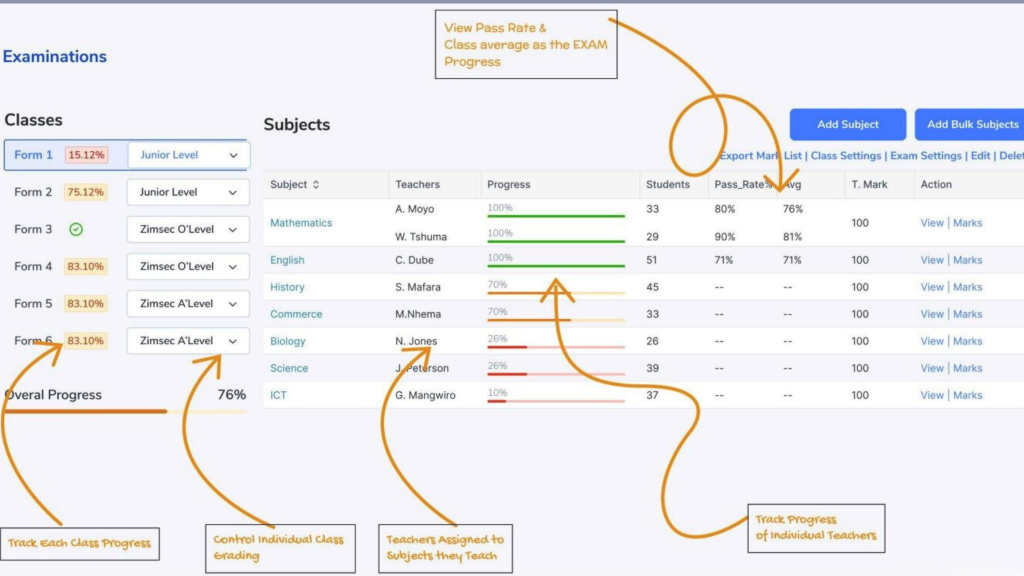
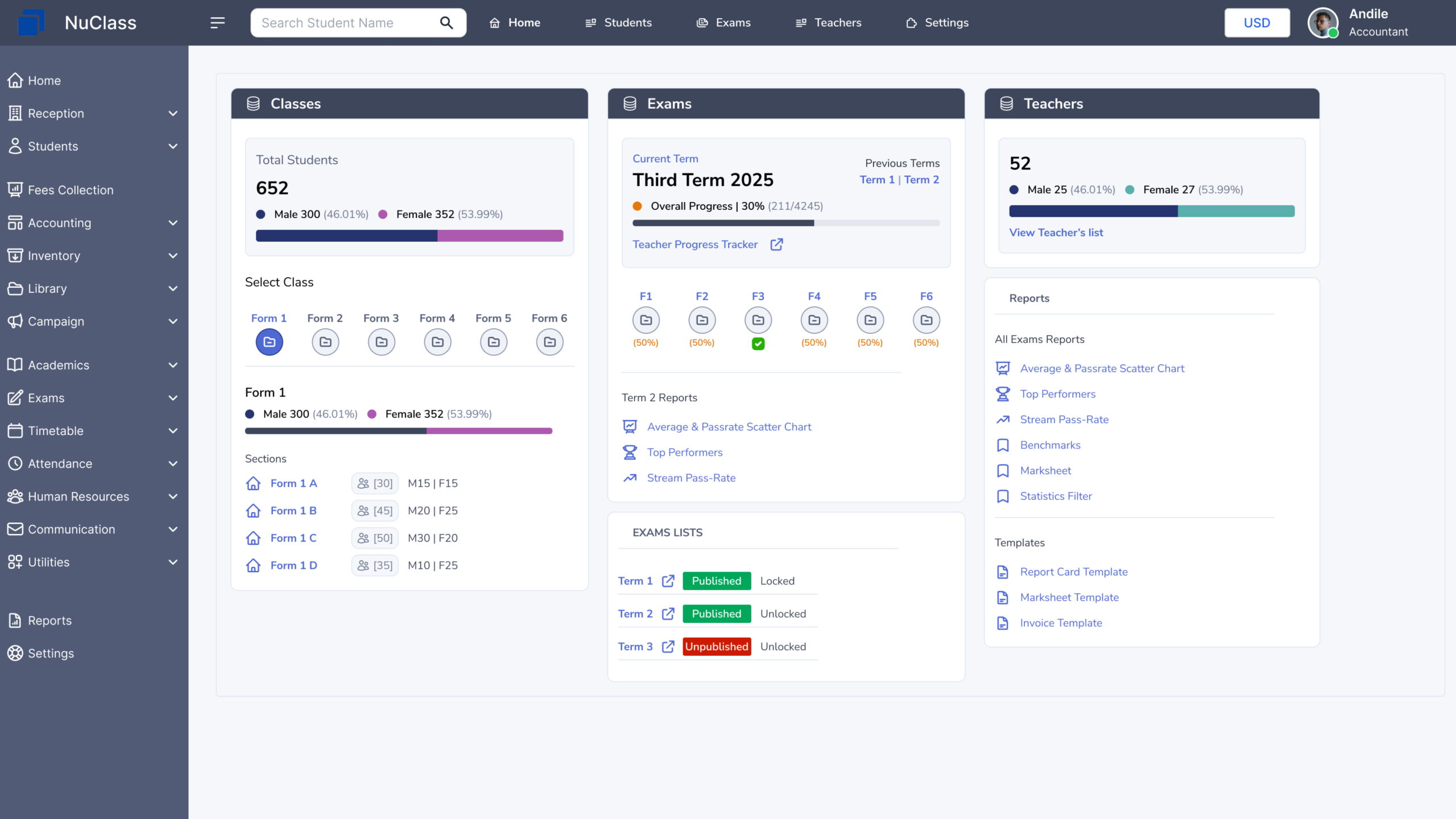
Below is Digitalised school examination dashboard showing class progress and pass rates in Zimbabwe
From Paper Records to Real-Time Insights
This dashboard illustrates what happens when schools digitalise academic monitoring.
Class performance, subject progress, and teacher activity are tracked automatically, giving school leadership immediate visibility into what is happening across the school.
Digitalisation turns examination data into actionable insight — helping schools improve results, accountability, and planning.
STEP 5: Store student records digitally
No more:
- lost files
- damaged folders
- missing documents
- repeated registration
Digital records save:
- personal details
- academic history
- attendance
- discipline
- achievements
It’s cleaner, safer, and lasts forever.
STEP 6: Digitalise Parent Communication and Fees Collection
When schools digitalise their systems, parent communication improves immediately. However, true digitalisation only happens when communication and payments work together in one connected platform.
For years, Zimbabwean schools have struggled with fees collection because parents were required to:
- bring proof of payment to school
- send screenshots via WhatsApp
- wait for balances to be updated manually
- resolve disputes caused by delayed confirmations
This manual process wastes time, creates tension, and slows down school operations.
Digitalise parent communication
A digital school system allows schools to:
- communicate with parents instantly
- share reports and notices digitally
- improve transparency and trust
- reduce paperwork and queues
Parents already live in a digital world. Schools that digitalise their communication meet parents where they are.
Digitalise fees collection – Powered by NuPay
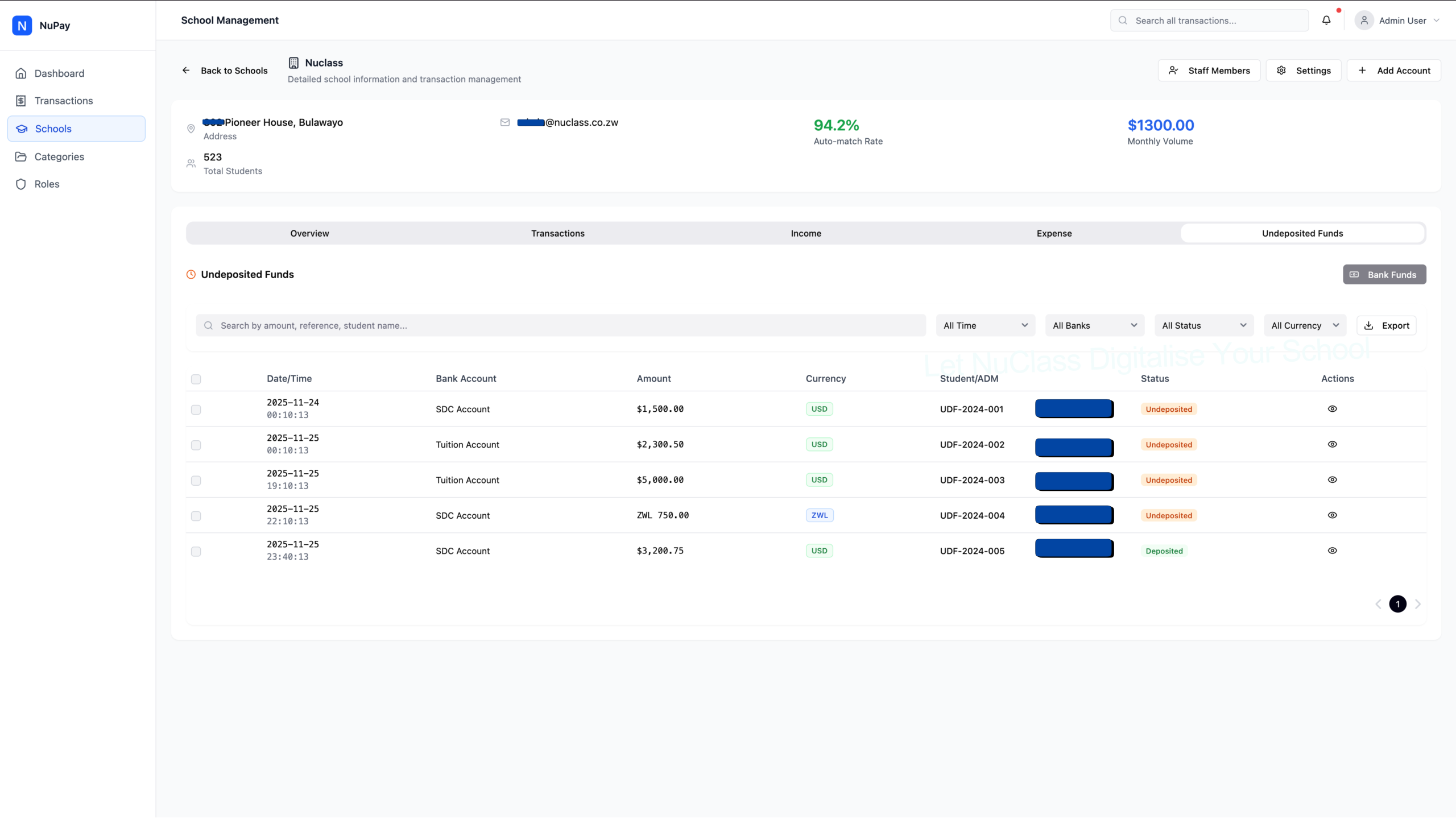
NuClass now includes NuPay, a fully integrated digital fees collection solution designed specifically for Zimbabwean schools.
With NuPay, parents can:
- pay school fees directly at the bank or via EcoCash
- make payments without bringing proof of payment to the school
Once a payment is made:
- the transaction reflects immediately on the school system
- the learner’s fees balance updates automatically
- school administrators no longer need to manually reconcile payments
NuPay connects banks, mobile money platforms, parents, and the school into one secure digital system.
What this changes for schools
By using NuPay, schools:
- eliminate lost or delayed proof of payment
- reduce queues at the bursar’s office
- avoid disputes over fees balances
- maintain clean, real-time financial records
Administrators can see exactly:
- who has paid
- how much has been paid
- outstanding balances
- payment history per learner
All without leaving the NuClass system.
Completing the digital school ecosystem
Many schools manage to digitalise academics but leave finance behind. This creates a gap where:
- attendance is digital
- marks are digital
- reports are automated
- but fees are still manual
NuPay closes this gap.
By digitalising:
- communication
- academic administration
- performance analytics
- and fees collection
schools operate as fully digital institutions.
NuClass does not only digitalise classrooms — it digitalises the entire school operation, ensuring efficiency, transparency, and professionalism from the first day of term.
STEP 7: Add analytics for leadership decisions
This step separates good schools from great ones.
Analytics show:
- class performance
- subject trends
- student improvement patterns
- teacher strengths and challenges
NuClass provides V33 and V34 analysis automatically — something that used to take hours manually.
STEP 8: Expand slowly to other areas
Once your foundation is strong, you can expand into:
- Fees management
- Digital time-tables
- E-learning tools
- Online homework
- Digital library systems
- Staff attendance systems
Digitalisation should be gradual, not rushed.
4.Common Mistakes Zimbabwean Schools Must Avoid When they Digitalise
Many Zimbabwean schools rush into digitalisation with good intentions but end up frustrated, wasting money, or abandoning systems altogether. These mistakes are not caused by lack of effort, but by poor planning, wrong tools, and unrealistic expectations. Understanding these common digitalisation mistakes helps schools transition smoothly and avoid costly setbacks.
1. Buying expensive equipment first
Digitalisation is not about laptops — it’s about systems.
2. Choosing complex systems
If teachers can’t use it easily, the system will fail.
3. Forcing change too fast
Digitalisation is a journey, not a one-day event.
4. Not involving teachers
Teachers must feel confident and supported.
5. Using international systems
International systems don’t understand Zim curriculum, prices, or school structure.
NuClass succeeds because it is built in and for Zimbabwe, not imported.
5. Key Benefits Within the First Term After You Digitalise a School in Zimbabwe
Many school heads worry that digitalisation takes years to show results. In reality, Zimbabwean schools that adopt simple digital systems begin to see clear improvements within the first term. From reduced teacher workload to faster reporting and improved parent communication, the impact is immediate and measurable.
Schools that use NuClass report:
✔ Faster admin processes
Report cards ready in hours, not weeks.
✔ Increased teacher satisfaction
Less admin stress, more time for teaching.
✔ Improved parent engagement
Parents receive timely, clear reports.
✔ Cleaner, accurate data
No errors in marks, grades, or averages.
✔ Strong leadership decisions
Heads finally have real data to work with in real time.
✔ More professional school image
Parents, inspectors, and communities trust the school more.
6. Why NuClass Is the Easiest Way to Digitalise Your School in Zimbabwe
Choosing the right digital system determines whether school digitalisation succeeds or fails. Many platforms promise advanced features but end up overwhelming teachers and administrators. NuClass was built specifically for Zimbabwean schools, focusing on simplicity, affordability, and real classroom needs — making it the easiest way for schools to go digital.
NuClass leads digital transformation in Zimbabwe because:
✓ It works on low networks
Perfect for rural and slow network areas.
✓ It is easy for teachers to learn
Most teachers understand it the same day.
✓ It supports ZIMSEC subjects
No international confusion.
✓ It automates everything
Marks → Exams → Reports → Analytics.
✓ It is affordable
Designed with Zimbabwean budgets in mind.
✓ It is modern and reliable
Built for 2025 and beyond.
⭐ Final Thoughts
Digitalising a school in Zimbabwe is not a dream — it’s a necessity.
Schools that do it now will stand out in efficiency, parent satisfaction, and academic performance.
The good news?
Digitalisation doesn’t need special labs, expensive devices, or complicated IT.
You only need:
- a simple digital system
- teachers willing to learn
- leadership that wants progress
NuClass makes this transition smooth, affordable, and empowering for any school — rural or urban, small or large.
If your school is ready to enter the future: