

School heads, administrators, and School Development Committees (SDCs) in Zimbabwe may want to modernise their schools by moving from manual systems to digital platforms. However, before making that transition, one question always comes first:
“How much does a school management system cost in Zimbabwe?”
“Is a school software affordable for our school?”
“Will the benefits justify the price?”
These concerns are genuine — especially for schools operating under tight budgets, unstable fee collections, and limited resources.
The truth is simple:
A well-designed school management system does not have to be expensive — especially when it is built locally for Zimbabwean schools.
In this guide, we break down:
- What determines the price of a school management system in Zimbabwe
- Realistic cost ranges schools should expect in 2026
- Why local systems offer better value than imported platforms
- How digital systems save money long-term
- Why NuClass, including its NuPay digital school payments system, offers exceptional value for Zimbabwean schools
1. What Determines the Price of a School Management System in Zimbabwe?
Not all school management systems are priced the same. Several factors influence how much a school pays.
a) Features Included
The most important cost driver is what the system can do.
A system that includes:
- Attendance management
- Marks capture and grading
- Automated report cards
- Performance analytics
- Parent communication
- Discipline records
- Staff management
will naturally cost more than a system offering only one or two basic features.
However, schools must focus on value, not just price. A slightly higher subscription that replaces multiple manual processes usually saves more money in the long run.
b) Number of Students
Most systems price according to student numbers or student brackets.
- Smaller schools pay less overall
- Larger schools pay more in total, but often less per student
For example, a school with 1,000 learners may pay more than a school with 150 learners, but the cost per learner is usually significantly lower.
c) Local vs International Systems
This is where pricing differences become very noticeable.
International systems are often expensive because they:
- Charge in international currencies
- Include features not relevant to a local school.
- Assume private-school budgets
- Require fast and reliable internet
- Offer limited or delayed local support
Local systems like NuClass:
- Are priced for Zimbabwean schools
- Work well on low bandwidth
- Support ZIMSEC structures
- Offer local training and support
- Understand real school challenges
d) Payment Model Used
Most modern systems use a subscription model, which can be:
- Monthly
- Termly
- Yearly
Subscriptions usually include:
- Software access
- Updates and improvements
- Technical support
Subscription price are usually designed to cover continous software updates and web hosting expenses.
e) Training, Setup, and Support
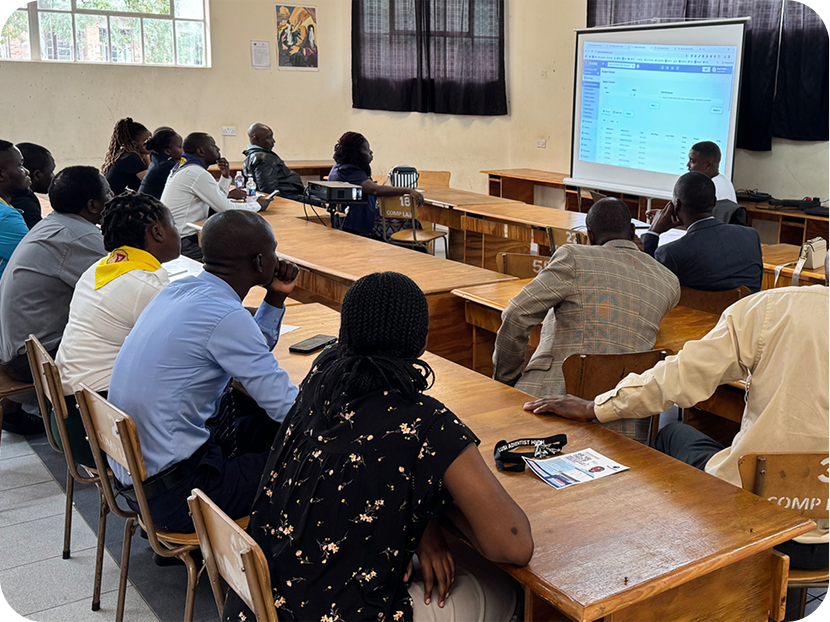
Some providers charge extra for:
- Initial setup
- Teacher training
- Ongoing support
NuClass focuses on simple onboarding, affordable support, and teacher-friendly design to keep overall costs manageable.
f) Optional and Advanced Modules
Some schools choose to add modules such as:
- Fees management
- Parent portals
- Staff attendance tracking
- Timetable generation
- Academic analytics
- Digital payments
These can affect pricing depending on school needs.
2. How Much Do School Management Systems Cost in Zimbabwe? (Realistic Ranges)
Below are industry-realistic estimates Zimbabwean schools should expect in 2026. These are averages, not fixed prices.
✅ Small Schools (50–300 learners)
Typical cost range:
- $200 – $450 per term
Usually suitable for:
- Attendance tracking
- Marks entry
- Report cards
- Basic communication
✅ Medium Schools (300–800 learners)
Typical cost range:
- $300 – $700 per term
Often require:
- Multiple streams
- Subject analytics
- Discipline tracking
- Detailed academic reports
✅ Large Schools (800+ learners)
Typical cost range:
- $600 – $1,200 per term
Common needs include:
- Complex subject combinations
- Examination analysis
- Parent portals
- Advanced reporting tools
❗ What This Means for Schools
- Any school in Zimbabwe can afford a digital system
- Pricing is flexible and scalable
- Local platforms are far more cost-effective than imported ones
3. Is a School Management System Worth the Price?
Many schools underestimate the hidden costs of manual systems.
Manual systems often lead to:
- Teacher overtime
- Extra administrative staff
- Excessive printing costs
- Marking errors and disputes
- Lost or damaged records
- Poor inspection readiness
- Stress and burnout
These costs add up silently every term.
✅ Digital Systems Save Money Long-Term
A digital system:
- Eliminates printing errors
- Prevents lost records
- Improves accuracy
- Saves teachers’ hours weekly
- Simplifies inspections
- Improves leadership decision-making
Most schools recover the system cost within a short time through efficiency alone.
4. Why Local Systems Are Better for Zimbabwean Schools
Zimbabwean schools operate under unique conditions:
- Limited connectivity
- Budget constraints
- ZIMSEC-specific requirements
- Mixed rural and urban environments
International systems often fail to adapt to these realities.
Local platforms like NuClass are designed to:
- Work on low data
- Support all ZIMSEC subjects
- Automate report cards
- Run on basic smartphones
- Provide reliable local support
5. Introducing NuClass NuPay – Digital School Payments Made Simple
One of the most powerful additions to NuClass is NuPay, the integrated school payments system.
What Is NuPay?
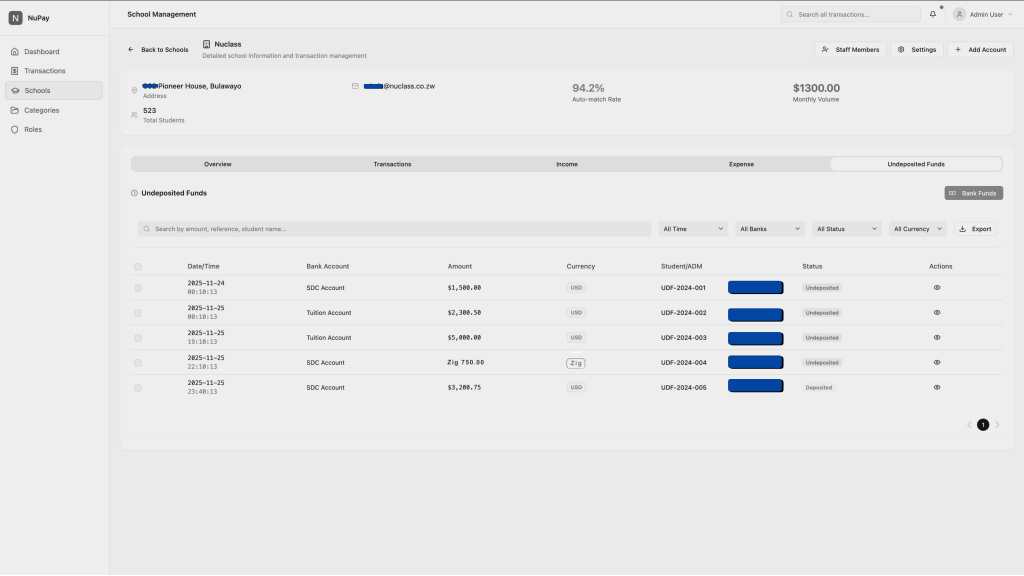
NuPay is a secure digital payment solution built into the NuClass ecosystem, designed specifically for Zimbabwean schools.
It allows schools to:
- Collect fees digitally
- Track payments in real time
- Reduce cash handling
- Improve financial transparency
How NuPay Reduces School Costs
NuPay helps schools:
- Eliminate manual receipt books
- Reduce financial errors
- Avoid lost payment records
- Speed up reconciliation
- Improve accountability
Parents benefit too — payments are easier, faster, and traceable.
NuPay and Financial Planning
With NuPay:
- Administrators see outstanding balances instantly
- Reports are generated automatically
- Financial planning becomes data-driven
- SDCs gain better oversight
This turns school finances into a well-managed system, not guesswork.
6. Why NuClass Offers the Best Value for Money in Zimbabwe
NuClass is one of the most cost-effective platforms available because it combines academic management, analytics, and digital payments in one system.
Key Benefits at a Glance
- Transparent and affordable pricing
- Attendance, marks, and reports included
- Automated report cards
- AI-powered academic insights
- V33 (academic) and V34 (sports & co-curricular) analysis support
- NuPay digital payments
- Works in rural and urban schools
- Local training and support
👉 [Add internal link to NuClass pricing or homepage]
7. Choosing a School Management System Based on Value, Not Just Price
When comparing different school management system prices in Zimbabwe, schools should avoid choosing software based only on the cheapest option.
Key Questions Schools Should Ask:
- Does the system save teacher time?
- Does it reduce errors and admin stress?
- Is local support available?
- Does it support ZIMSEC requirements?
- Can it grow with the school?
A slightly higher-priced system that delivers reliability, support, and long-term value often proves cheaper over time than a low-cost system that fails under real school conditions.
⭐ Final Thoughts
The price of a school management system in Zimbabwe depends on:
- School size
- Required features
- Payment model
- Whether the system is local or imported
But the real question is not cost — it is value.
A good system:
- Saves time
- Improves accuracy
- Reduces stress
- Enhances school reputation
- Strengthens financial management
- Prepares schools for the future
NuClass delivers all this at a price Zimbabwean schools can afford.
👉 Book a Demo Today WhatsApp Samantha
Do you want to learn more? Click the link below: